Hello again friends!
We had a full day yesterday (Monday for us). We began our day in the Science Cargo building, where most of the gear we will require on our trip has been stashed. First order of business was to assemble our "sleep kits." All members of a field party are issued a sleep kit. The fundamental ingredients of a sleep kit are:
- a -40 degree F sleeping bag,
- a fleece sleeping bag liner,
- a pillow,
- a foam mat,
- a thermarest,
- and a pee bottle (consider your options for a middle-of-the-night restroom break when weather conditions are extremely bad).
We add a few additional items: a personal first aid kit, a water bottle, a thermos, a signal mirror (used mostly for applying sunscreen), a couple of rolls of toilet paper, antibacterial wipes, and a camp chair.
 |
| Matt assembling his sleep kit! |
 |
| Kat modeling the fleece sleeping bag liner. |
 |
| It is very important to clearly label your pee bottle. We keep our water bottles in insulating sleeves (Matt's holding a red one) to keep them from freezing. |
 |
| Camp chairs are a must for in-camp comfort. |
One of our main tasks this week will be to pack all of our cargo in preparation for transport to our field location next week. Each small item needs to be packed in a container that can be put on a pallet (such as a wooden or cardboard box), each pallet or large object (such as a tent) needs to be weighed, measured and logged in a cargo manifest. We may have as much as 20,000 pounds of gear when we're done. We'll report the final numbers when we know them!
 |
| Triwalls (triple-layer corrugated cardboard) are a common way to prepare gear for transport on a pallet. |
(I'm not sure what all of the white dots in these photos are. I will fix it before I take more photos!)
 |
| We have 250 sample bags! I'll explain more about what we're sampling and why in a later post. |
 |
| We also equip ourselves to capture, absorb, or contain spills of liquids such as fuel! These supplies are provided by the USAP's Environmental Services team. The tan container on the ground is a berm that we'll place beneath all of our camp stove fuel to prevent contamination of our field camp location. The spill kit contains different kinds of absorbent pads that can be used to clean up a spill. |
 |
| We are issued a kitchen box which contains a wide variety of cooking supplies including dishes, a coffee pot, dish soap, pans, and cooking implements. |
 |
| We also have to capture our human waste! Seth is modeling a waste bucket and our toilet seat! |
Some of our gear we are preparing for use in an overnight "shakedown" trip. This afternoon (Tuesday for us!), we are going to snowmobile most of our camp gear out to a location near Mount Erebus (the volcano near McMurdo) about 9 miles from the station. We will set up camp and test out all of our gear to make sure that we have everything we need and that everything is functioning properly. We will also practice our glacier travel skills while we are away from station.
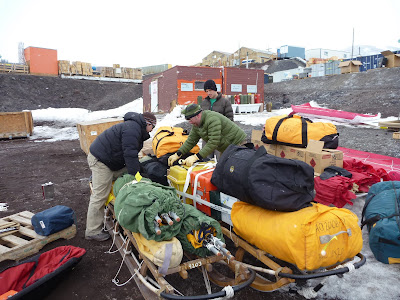 |
| We will transport our gear via sleds towed by snowmobile! These sleds are called Nansen sleds, after the explorer Fridtjof Nansen who adapted this design from Inuit sleds. |
 |
| On these sleds, we've loaded three Scott tents (you'll see pictures of these later this week!), our sleep kits, the kitchen box (the yellow box on the right), an HF radio (the orange box behind it), and a box of food (not visible). |
 |
| Weather yesterday was a bit cloudy. It even snowed a little bit. |
 |
| Strapping gear onto sleds is a team effort! |
We spent Monday afternoon refreshing our knot tying and climbing equipment skills. With our mountaineer Chris as our guide, we sized our harnesses, helmets, and practiced tying different knots we'll need to safely travel potentially-crevassed areas.
 |
| Kat and I showing off our sized harnesses, and our knot-tying skills. |
 |
| More knot-tying. |
 |
| Seth showing off his prussik cord. Prussiks can be used to ascend a rope out of a crevasse. More on this later! |
 |
| Our personal glacier travel equipment! On the left, we have a picket and an ice axe. At the top is a helmet. Attached to the harness (from the top) are: locking carabiners, an ice screw, an ascender, ropes for prussiks, and a loop of webbing. These supplies would help us to climb out of a crevasse if we fell in, or to build an anchor we could use to pull a friend out of a crevasse. More on this later! |
 |
| Seth, an avid and accomplished climber, is fired up! |
After a nice dinner in the galley, we wound down our day.
This morning, we had a snowmobile refresher course. Toby, the lead snowmobile mechanic on station, gave us a short-course in snowmobile anatomy, operation, maintenance and troubleshooting.
 |
| Our team has been issued four Bombardier Ski-doos. |
In a few hours, we will take our ski-doos on an overnight shakedown trip. Great pictures will follow, I promise!
All the best to everyone at home,
Claire




Hi Claire,
ReplyDeleteI sent you an email earlier today regarding ARRA reporting. Pls ignore it. I did not know you left for your trip already. I enjoy reading your postings.
Take care and be safe. . .
~gemma
Looks like Claire got some sun! :)
ReplyDelete