Hello Friends,
First, our flight news - we're now on Monday's flight schedule. This change gives us another weekend in McMurdo! Our flight on Friday was canceled due to weather at the South Pole, where our pilots have to stop to refuel on the way back from our field site. Today (Saturday here in McMurdo), the New York Air National Guard is bringing in new crews to relieve those who have been on duty, so some flights are delayed until this change is complete. NYANG's 109th Airlift Wing maintains the only LC-130 fleet in the U. S. Air Force (the 'L' indicates the C-130 aircraft has skis). When they're not flying scientists and staff to and from Antarctica (during the southern hemisphere winter), NYANG crews fly scientists and staff to and from Greenland! (As a side note, the 109th flew a search and rescue mission to investigate this situation yesterday.) We are appreciative of the service of the 109th!
Given another weekend in town, we're finding ways to entertain ourselves. Yesterday, we toured the station's reverse osmosis desalination plant. Today, we're hoping to tour the wastewater treatment plant. Tomorrow, I've scheduled us for a tour of one of Robert Scott's huts! You are in for a lot of blog posts this weekend!
Let's start with a virtual tour of our current home.
 |
| Seth took this picture from the top of Observation Hill in December 2010 (Photo courtesy of Seth Campbell!). I've labeled the locations where we spend the most time. The large circular features are fuel tanks! |
On Thursday, Matt and I spent what we thought was our last day in town on a photo tour of the station; yesterday and today (Saturday for us), I visited a few more locations to supplement our original tour.
Most of our days begin in the Galley.
 |
| Kat on her way to breakfast this morning! Breakfast is served until 7:30 in the morning. We set our alarms for seven; on slow mornings, we're sometimes making it just before the Egg Bar closes! I will definitely miss fresh eggs while we're in the field. |
In order to avoid spreading colds and the flu around station, everyone is strongly encouraged to wash their hands frequently. Before walking into the Dining Room, we are required to stop at the hand-washing station!
 |
| We eat very well here. With every new flight from Christchurch, another batch of fresh fruits and vegetables arrives. There are always many options, lots of baked goods, and a soft-serve ice cream machine! |
 |
| Chris is on his way to our office. All around town holiday decorations are popping up. Hard to believe Christmas is a week away!! |
As I mentioned above, Matt and I explored the station on Thursday to document the sights around town for you. It is hard to overstate the level of activity in the station! Motorized vehicles are on the move at all times everywhere (watch for a Trucks Part II post!). Need a ride? There are shuttle buses and taxis!
 |
| Not much longer until the next bus arrives! Buses are typically 12-passenger vans. Most of the shuttle service is dedicated to delivering workers to and from the Ice Runway each day. |
 |
| Do you need a ride outside of scheduled shuttle service? Call a McMurdo taxi! During busy "bag drag" times, when many residents are checking in for flights, all taxis are deployed to the streets of McMurdo. You can actually hail a taxi from outside of your dorm! |
 |
| There is a lot of infrastructure around town dedicated to managing snowmelt. Observation Hill is visible in the background of this photograph. |
 |
| You can strengthen mind and body! In addition to a weight room, there's a gym dedicated to cardiovascular exercise machines, a gym with a basketball court and an indoor rock-climbing wall! |
 |
| We're not sure what happens in Antarctica's House of Blues. |
 |
| Matt says that the curling equipment box actually contains brooms! |
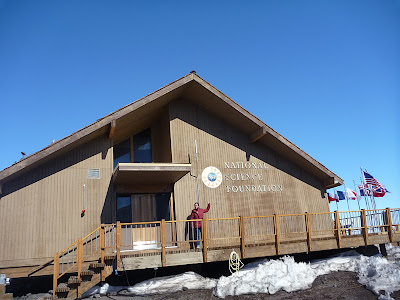 |
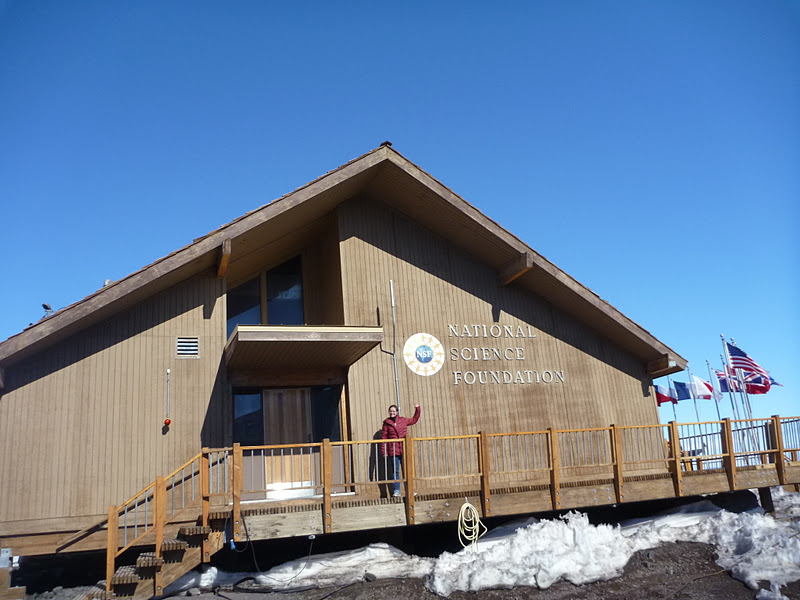
| The National Science Foundation is housed in a building affectionately referred to as the "Chalet." |
 |
On the deck of the Chalet is a bust of Admiral Richard E. Byrd who spearheaded early U. S. scientific research efforts in Antarctica. His autobiography Alone describes his work, including spending a winter season on the continent alone (!!) in the 1930s. At the base of this bust is the following quote from Admiral Byrd:
"I am hopeful that Antarctica
in its symbolic robe of white
will shine forth as a continent of peace
as nations working together there
in the cause of science
set an example of international cooperation." |
Another source of activity is the helicopter landing pad at the edge of town. Field parties traveling to nearby sites are supported by helicopter.
 |
| Matt took this picture of me midday yesterday; three of the five USAP helicopters were in use. The white area beyond the helo pad is snow-covered sea ice! Beyond the sea ice is the Royal Society Mountain Range. |
 |
| Greg captured this Bell 212 helicopter taking off earlier this week (Photo courtesy of Greg Balco!). |
 |
| This A-star helicopter belongs to Helicopters New Zealand, who is the contractor for Antarctica New Zealand. |
 |
| When helicopters are parked on the helo pad the rotor must be secured. |
After photographing the helicopter facility on Friday, we walked along the McMurdo beach!
 |
| McMurdo Sounds is currently covered by sea ice. It is sometimes completely ice-free by the end of February! |
 |
| At the beginning of the season when the sea ice is thicker, the sea ice surface is covered with these huts. When we landed at McMurdo in a C-17 on December 1st, the Ice Runway was located on the sea ice! Thinning ice forces Ice Runway operations onto the thicker Ross Ice Shelf for the rest of the season. Can you see the skids at the bottom of this hut? These skids facilitate transport of the huts by tracked vehicles on and off of the sea ice surface. Common hut activities when they are located on the sea ice include scientific expeditions that require divers to descend through many feet of sea ice to access McMurdo Sound. |
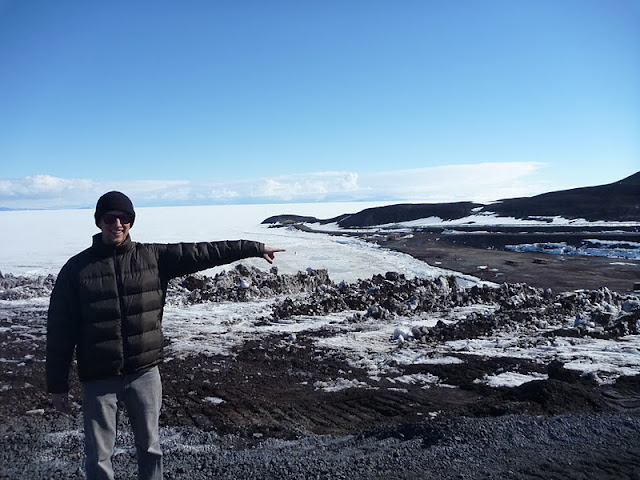 |
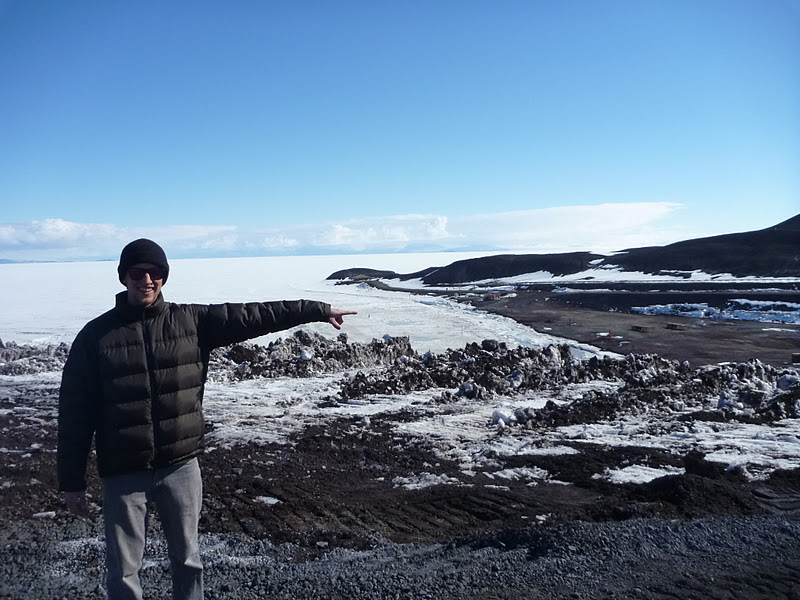
| McMurdo Station (and South Pole Station, indirectly) is resupplied by ship every February. Here, Matt is pointing to the ice pier. In January, an icebreaker creates a path in the sea ice so that resupply ships can access the ice pier. To learn more about the icebreaker that will be serving the station this season click here - we're borrowing one from the Russians! Two ships will follow in the icebreaker's path: an oil tanker and a cargo ship. Our geologic samples will travel back to the United States on the cargo ship! We will not receive our samples until April! |
 |
| Greg took this picture of the Research Vessel Icebreaker Nathaniel B. Palmer in 2005. Greg informs me that Nathaniel B. Palmer was captain of sealing vessel in the 19th century. Palmer and his crew are believed to be some of the first people, and the first Americans, to discover the Antarctic Peninsula. Greg also tells me that Palmer's house still stands in Stonington, Connecticut; a tourist destination if you're in the area! In this picture, the ice pier has been covered by dirt, to add traction for wheeled vehicle access and to reduce melting of the ice pier by solar radiation. |
 |
| The US Antarctic Program photo gallery (available here) offers this great shot of the Palmer at the ice pier in February 2011 (Photo credit: Jeff Scanniello, National Science Foundation). |
Back to town we go! Hopefully, you'll never need one of these, but it's nice to know that they're available if necessary.
The ambulance can deliver you to McMurdo General Hospital!
In the evenings, we find many ways to keep ourselves busy. Last night there was a back country skiing film festival showing in the Galley, a dance party at one of the social establishments on station, and a group of scientists playing Ping Pong in the lounge of their dorm!
Non-stop fun and excitement around here! More posts to come later today. Hope all is well at home. Happy Friday!
Claire






No comments:
Post a Comment